
The 5 Lenses: A Clear Framework for GTM Strategy
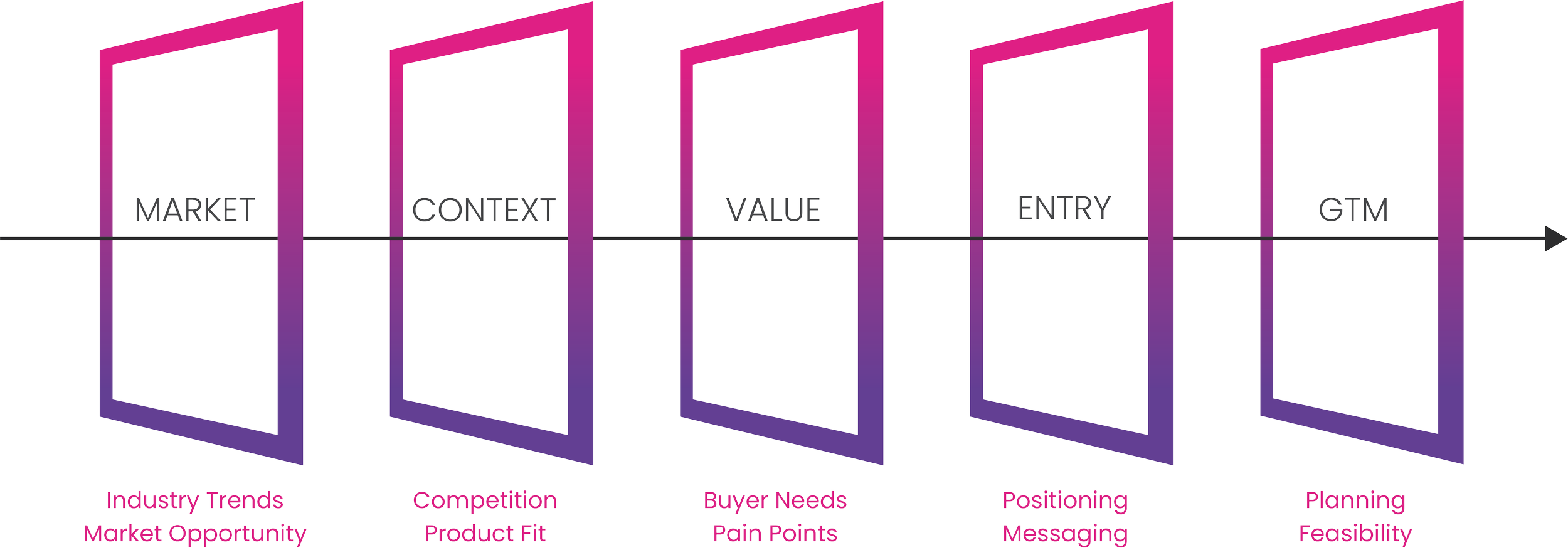
Posture’s 5 Lenses Approach to GTM Strategy
Executive Summary
Root Cause of GTM Failure: Most strategies fail not due to poor execution, but because teams bypass foundational alignment to focus prematurely on tactics like messaging and campaigns.
The Executive Misalignment Trap: Without a shared framework, Product, Sales, and Marketing often optimize for siloed goals, creating the illusion of progress while failing to drive collective business results.
The "System" Over the "Silo": Effective Go-To-Market strategy requires an organization-wide shift from individual department targets to a unified system that defines where to compete and how to win.
Sequence Matters: The "5 Lenses" provides a disciplined decision-making order—starting with market reality rather than product assumptions—to ensure communication remains consistent under pressure.
The 5 Lenses
Most go-to-market strategies don’t fail because teams can’t execute. They fail because they start from the wrong place. Teams jump straight into messaging, campaigns, and tactics without first getting aligned on the fundamentals. The result? Lots of activity, very little impact.
At the executive level, this creates a bigger issue: misalignment across teams. Product, marketing, sales, and customer success all move forward—but not in the same direction. It looks like progress on the surface, yet results don’t follow.
What’s needed is a structured way to think about GTM—one that balances clear storytelling with disciplined decision-making. A model that brings clarity to choices, puts things in the right order, and keeps communication consistent across the organization.
That’s where the five lenses come in. It’s a practical way to build, communicate, and execute a GTM strategy that holds up under pressure.
Why GTM Structure Matters at the Executive Level
At scale, go-to-market isn’t just about launching products. It’s about aligning the entire organization around a shared view of where to compete, how to win, and what matters most right now.
Without that alignment, even strong teams optimize for their own goals. Marketing focuses on campaigns. Sales focuses on pipeline. Product focuses on features. But no one is optimizing the system.
The five lenses addresses this by creating a shared narrative and a clear sequence for decision-making.
The 5 Lenses of Go-To-Market Strategy
1. Market: Start With Reality, Not Assumptions
The first lens is the market. Not the product. Not the messaging. The market.
This lens answers two critical questions: is this worth doing at all—and is the market moving toward us or away from us?
At this stage, leaders should focus on industry trends and market opportunity. Where is demand growing? Where is investment flowing? What shifts are accelerating adoption—or slowing it down?
It is not enough to identify a market. You need to understand its direction. A market moving toward you creates tailwinds. A market moving away creates friction that no amount of execution can overcome.
If the market lens does not hold, everything downstream becomes performative GTM. You can launch beautifully into a market that simply does not care.
This is why the market lens comes first. It ensures that every downstream decision is grounded in external reality, not internal ambition.
2. Context: Understand the Playing Field
Once the market is validated, the next step is context.
Context is about competition and product fit. It answers the question: what already exists—and where do we fit, not where we wish we fit?
This distinction is critical. Most teams unintentionally position themselves based on aspiration rather than reality. They describe the category they want to win in, not the one buyer would place them in today.
Buyers do not make decisions in isolation. They compare options. They rely on existing tools. They operate within ecosystems that already solve the problem in some way.
This lens forces organizations to confront that reality. It requires a clear understanding of competitors, alternatives, and how your product truly stacks up in the current landscape.
Without this clarity, differentiation becomes self-referential. Your positioning may feel original internally, but it will not hold up externally because it is disconnected from how buyers already think and decide.
Context keeps the strategy honest by grounding it in data, evidence, and real buyer behavior.
3. Value: Define What Actually Matters to Buyers
At the center of the framework is value.
This lens answers two critical questions: why would someone care—and what problem is meaningful enough to trigger action?
Value is not about creating urgency through fear or overstating pain. It is about placing the buyer clearly in the story of the product and showing how they move forward with advantage.
This means understanding how the buyer operates today, what they are trying to achieve, and where there is an opportunity to fix a problem, alleviate stress, improve outcomes. To demonstrate how your product helps them operate more effectively, make better decisions, or compete more successfully.
This lens forces teams to articulate value in the buyer’s language, not the product’s language. It reframes the conversation from features to impact—what changes for the buyer once this is in place.
When value is clear, it creates alignment across teams. Sales can tell a more credible story. Marketing can communicate with precision. Product can prioritize what drives adoption.
Value is the anchor that gives the rest of the GTM motion gravity.
4. Entry: Control How You Show Up
With value defined, the next lens is entry.
Entry is about positioning and messaging. It determines how you enter the buyer’s mind and the market conversation.
Positioning defines the frame. It answers: what category are we in, and how should we be understood?
Messaging fills in the details. It translates value into language that resonates with the buyer.
The critical insight here is sequencing. Entry only works if it reflects the first three lenses. If it does not, buyers will feel the disconnect immediately.
Positioning defines how you are understood. Messaging determines whether that understanding translates into action. Together, they shape not just perception, but adoption.
5. GTM: Turn Strategy into Execution
Only after the first four lenses are clear should teams move into go-to-market execution.
This lens focuses on planning and feasibility. It answers: can this be executed?
This includes defining timelines, allocating resources, setting budgets, and aligning teams on roles and responsibilities.
Execution without grounding leads to wasted effort. Teams stay busy, but outcomes remain inconsistent.
By contrast, when execution is built on the prior lenses, it becomes focused and efficient. Every activity ties back to a clear strategic foundation.
How to Use the Five Lenses in Practice
The power of this framework is not just in its structure; it is in how it enables communication.
Each lens acts as a checkpoint. It gives stakeholders visibility into where decisions are being made and why.
Instead of debating tactics too early, teams align on fundamentals first. Instead of reacting to problems, they diagnose which lens is breaking.
For executive teams, this becomes a tool for both strategy and governance. It ensures that go-to-market is not just a series of initiatives, but a coherent system.
Q&A: Common Questions About the 5 Lenses Framework
Q: Can we skip lenses if we are moving fast?
No. Speed without sequence leads to rework. Skipping lenses often results in misalignment that slows execution later.
Q: Where do most teams go wrong?
Most teams rush to value or messaging before validating market and context. This creates weak positioning and unclear differentiation.
Q: Is this framework only for large organizations?
No. Startups benefit just as much—often more—because resources are limited and decisions need to be precise.
Q: How often should we revisit the lenses?
Continuously. Markets shift, competitors evolve, and buyer needs change. The lenses are not one-time steps—they are ongoing perspectives.
Q: How does this help with cross-functional alignment?
It provides a shared language and sequence. Teams understand where they are in the process and how their work connects to the broader strategy.
Closing
The five lenses turn go-to-market from a reactive process into a structured system. It aligns teams, clarifies decisions, and ensures execution is grounded in reality.
When something breaks in GTM, the question is no longer “what tactic failed?”—it becomes “which lens did we skip or misunderstand?”
That shift changes everything.